
Making Less, More
On Attention, Endurance, and the Work That Lasts in an Age of Speed

In 1895, Ambroise Vollard already had a nose for trouble. He was stubborn, half-deaf, and largely unimpressed by Parisian fashion. Vollard wasn’t a tastemaker in the usual sense and rarely introduced art in his gallery on the Rue Laffitte that others immediately celebrated. He backed artists that most people considered baffling or outright failures. That was, in part, the nature of his genius. He trusted his eye more than consensus.
When Vollard decided to choose a provincial painter named Paul Cezanne for his first solo exhibition in Paris, it was in some ways closer to an act of faith, or even defiance. Cezanne was already in his fifties. He had been rejected more times than he could count, mocked for his clumsiness and unfinished canvases, and his avoidance of popular contemporary trends.
Vollard saw something else. A man not interested in playing by the rules of polite society.
By the time of the great retrospective at the Salon d’Automne in 1907, a year after Cezanne’s death, the critics had stopped laughing. He was seen as an indispensable gift to the art world. Roger Fry would later call him “the father of us all.” It was hardly a compliment that was handed out lightly. Though, this isn’t exactly a comeback story. It’s a recognition after the man had already spent his life. By the algebra of modern efficiency, Cezanne had done it all wrong. He was slow and repetitive. He painted the same apples, the same bathers, the same mountains, as if he was unaware of novelty. Today, undoubtedly, he would be told to diversify the portfolio, explore new markets, and scale scale scale. Instead the man kept returning to what inspired him.
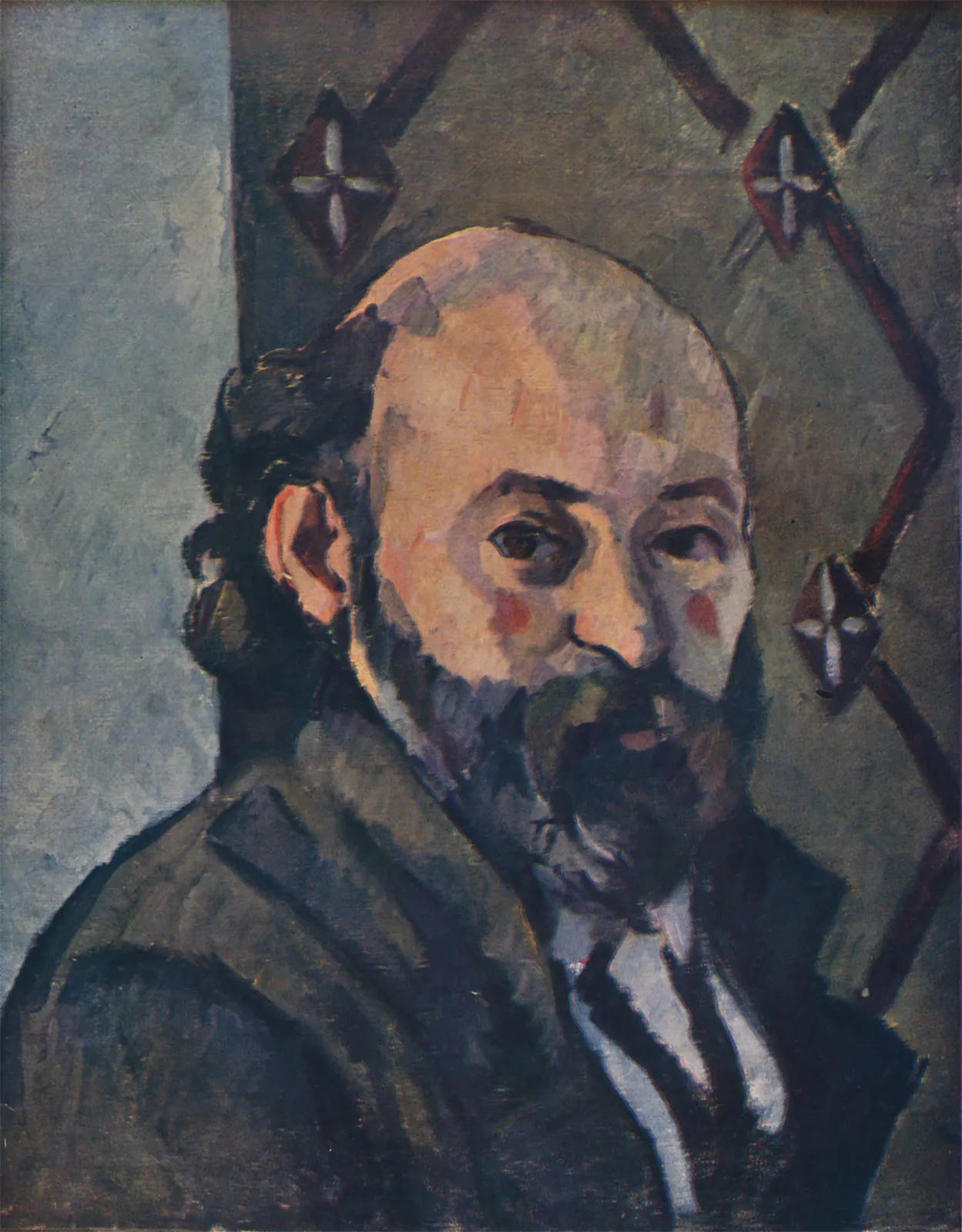
Cezanne was born in 1839 in Aix-en-Provence to a father who was a hatmaker turned banker. He was obsessed with reputation and respectability. In the small French community, your name mattered. Your future was something you chose early and then defended for the rest of your life. The young Cezanne was expected to study law and take his place inside a system that rewarded certainty and punished deviation. For a time, he did. However, most of the accounts talk about him as inward and difficult. The young man felt more at ease walking in the hills outside of Aix than speaking in classrooms. Together with his close companion Emile Zola, another restless son of Provence, they would roam the countryside, reading, arguing, and developing an appreciation of the land.
His father tolerated his art as a hobby, a phase. Though a dangerous one. When Cezanne finally insisted on leaving for Paris, he was given conditions and a meager allowance. It was hardly an act of generosity. The tension between father and son never fully resolved.
Paris was full of other ambitious artists when he arrived. Cezanne initially was optimistic and enrolled briefly at the Academie Suisse. There was very little real instruction, only bodies to draw and other artists to measure yourself against and he struggled. His early paintings were dark and almost violent. Critics later called them brutish and his peers were unsure what to do with him. The Salon refused to exhibit. According to art historian John Rewald, Cezanne absorbed these setbacks as proof that he was fundamentally out of step. He grew defensive and withdrawn. Paris simply did not equip him to succeed. It did, however, teach him to withstand failure.
As Impressionism began to take hold among the Parisian art world, Cezanne remained an outlier. Where others chased immediacy, he slowed things down. He distrusted effects or gimmicks. Rewald notes that Cezanne was already speaking about making something that would “last like the art of the museums.” He wanted his paintings to feel earned and to carry the density of lived time. The years there in Paris clarified his resistance.
He learned, slowly and painfully, that any art he wanted to make wouldn’t be born from acceptance. It would come from staying faithful to what refused quick resolution.
What emerges from the historical record is a man continuously clocking in to the slow and stubborn work of creation, regardless of who or who wasn’t impressed by it. He rose early, walked to his motif, set up, and painted often for hours. He complained constantly about his own inadequacy, but he kept going anyway. In letters, he described his days, “I am continuing to work very slowly, but I am making...” That word, continuing, shows up again and again. Cezanne would sometimes paint the same passage dozens of times. Another historian remarked that Cezanne painted “as if each canvas were a problem he had not yet learned to solve,” even after decades of work. And yet his ethic was not punishing. He had given up the young man’s game of volume or domination and only longed to be faithful to what he was seeing. He stopped when the light changed. He paused patientlty when the mountains withheld themselves from him. Cezanne sat with the thing until the thing surrendered its essence. Fidelity as practice.
He once wrote, “One must hurry slowly.” This line sounds almost playful until you sit with it long enough for its severity to show. Hurry, because life is finite. Because the body eventually tires. Because light moves. Because the day will not wait and we live within the resolute urgency of now. But go slowly. Because whatever is essential cannot be seized by force. It can only be approached very gently. Courted. Given time to arrive.
Cezanne understood that slow hurry is a refusal to confuse panic with significance. He worked with the knowledge that if he rushed the witnessing, he would get something that appeared finished but missed the mark. It is a discipline that protects against both despair and arrogance. This is why his days were repetitive without being stagnant. In a world that mistakes speed for conviction, Cezanne’s phrase reads like a protest. A reminder that devotion has a tempo and it is rarely fast. You move forward, yes. You put yourself in motion. But you do not outrun what you are trying to see.
Cezanne was interested in staying in honest relationship to his work. Showing up. Adjusting. Returning. This is daily practice of attention. A man willing to look foolish, slow, behind, while trusting that if he stayed long enough with what called him, something beautiful would take shape.
What is so compelling is that he refused to measure his progress by output. He measured it by contact. By how present he could stay true to what he saw.
What mattered was the fidelity of the encounter itself. This is where making less, more begins to move into practice. It is a way of consenting to depth. To choosing one thing and letting it work on you over time. To resist the reflex to move on the moment discomfort or rejection appears. Cezenne shows us that the work deepens through attention sustained long enough to become communion.

In the modern technologically driven world we are encouraged to do anything but hurry slowly. Social media and its algorithmic demands require near constant content generation. Every day we are asked to produce a new masterpiece, insight, or offering. Why? Because the consumer base has a short memory. The audience doesn’t remember what you did yesterday. You must stay visible and remind people that you exist. Stay on top of the latest trends, keep your name circulating, feed the machine so it doesn’t forget you.
Under these conditions, returning to the same questions looks irresponsible. Painting the same scenery looks naive. Staying with one body of work for years looks like a failure of imagination rather than a discipline of attention. We are told to pivot quickly in order to package our process as a product, to turn unfinished thinking into content before it has had time to metabolize. The result is a culture full of motion but lacking real vitality or movement. So much output. So little meaningful encounter. The deepest work asks us to risk being forgotten for a while so that what we make has a chance to become something solid and real.
Listen, the creative life wasn’t meant to be lived in isolation. You weren’t meant to go it on your own. That’s why over three years ago I started The Creators Collective, a place for shared resources, insights, and opportunities to deepen your sense of purpose and help you expand your own practice. Monthly LIVE masterclasses on Zoom, hundreds of hours of archived training and teaching, ongoing prompts, and a collective of other individuals learning how to show up fully to their own life! If this speaks to you, sign up now to get all the goods!
In the movie The Thirteenth Warrior, there is a depiction of an Arabic poet who finds himself in a Viking village. He is surrounded by strange and baffling practices he has to learn in order to survive. One day a longboat sails into the harbor and docks, yet the men don’t disembark. Instead they stand, stoic, on the prow, fully visible.Morning becomes afternoon, and still they hold. The poet is confused. Why, he wonders, aren’t they making landfall. Why just stand there doing nothing? A Viking warrior explains that they are waiting to be seen. To be recognized as more than creatures of the myst. They are showing that they are real, and not a transient presence. The Norse, in this story, understand that arrival without recognition is just noise. Movement without the ability to remain is hollow.
This is Cezanne’s posture. Standing at the edge of the hubbub. Refusing to rush into trendy performance. Allowing the work, the place, the questions to be fully acknowledged. In a culture obsessed with making landfall as quickly as possible, this provides a counter script, teaching us to linger at the threshold. To let attention make arrival real.
In my work with a noted filmmaker who had spent the last decade of his life moving from one project to another, relentlessly making, trying to stay ahead of the curve, I watched the cost of speed begin to show. It wasn’t burnout exactly but it was a kind of thinning. He could still execute, still pitch, still deliver, but when I asked him what he was actually curious about now, he went silent. He didn’t know what to say. It was like he couldn’t really hear his own heartbeat.
He told me later that he hadn’t stood still with a single idea in years. Every project was a kind of longboat that docked and was immediately unloaded. On to the next harbor. New notes. New collaborators. New urgency. The work kept landing, but there was no true arrival. There was no time for recognition, not from the audience, not from himself. He said he felt like vapor without gaining any traction, both everywhere and nowhere at once.
He thought he simply needed another opportunity to keep the fires burning. But that simply wasn’t true. What he needed was a threshold. Permission to stand on the prow and wait. To let an idea look back at him long enough to decide whether it wanted to be made at all. I encouraged him to make less, more. To consciously pump the brakes on the cycle of doing. He protested. Anxiety flared. Doubt. The creeping fear that without motion he would disappear. He had been trained to equate movement with worth, and was terrified of feeling devalued.
With some encouragement, he agreed to try something that felt almost reckless. He chose one simple idea. A partial, incomplete thought that wasn’t the most marketable or the cleanest pitch. It was one that had haunted him somehow and kept returning uninvited. I suggested he clear his calendar as best he could, and refuse to advance it towards production. No meetings or pressure to explain. To sit with it. That’s exactly what he did. He walked. Took notes in his journal that led nowhere. Daydreamed.
It all felt like laziness at first. He told me his hands itched. That every instinct screamed to move, to forward the thing. But gradually something shifted. He began to feel where the idea had previously resisted him, where it asked for more honesty and patience. In the absence of performance, the work started speaking.
In truth, what returned was gravity. A sense of contact. The idea developed density. It wasn’t certainty, but more or less something like substance. When he finally began to move ahead with the project several months later, it was with more conviction. The work carried a built in necessity. He had actually arrived. Making less, more was resistance. It was choosing fidelity over frenzy. It is deciding that what is stirring in you deserves more than constant interruption. That kind of attention isn’t passive. It’s muscular. Demanding. Transformative.
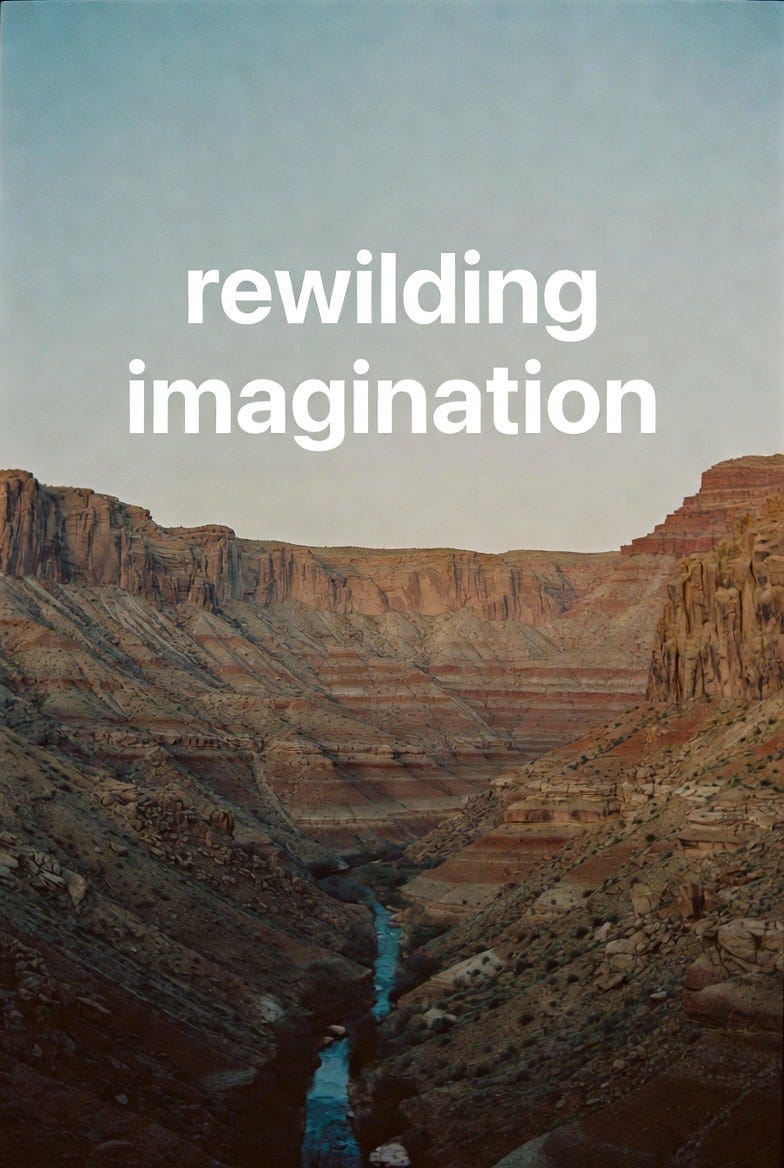
February 12-15 I’ll be hosting an intimate retreat in the Sonora Desert made to help return participants to their sense of inner spark. This is about remembering your passion for life, for creativity, and for hearing your own heartbeat. It will be a time of shared ritual, daily practice, and deeper insight. If you are longing for a space to return to your own wild imagination, I encourage you to apply. There are only a handful of spots left.
I’ll admit, this hasn’t always been natural for me either. Like many of us, my default setting was scatter and burst. Three hundred directions at once. Ideas multiplying faster than I could keep up with. Projects stacked on top of projects. Motion became a kind of reassurance. If I kept moving, then I didn’t have to listen too closely. I told myself this was curiosity, when in truth, I suspect it was fear dressed in drag. When my mother died whatever machinery had been driving my life seized up. It didn’t happen all at once. But quietly, the field of options collapsed. The horizon reduced itself to a fine point. The days simplified themselves without asking my opinion. Get up. Drink water. Answer this email. Sit with this grief. Write in my journal. Breathe. Stay open to the next honest step. What surprised me wasn’t the slowness, but rather the clarity it brought. When life stripped itself down, attention followed. I couldn’t hold many things at once, so I stopped trying. I learned what it felt to choose one small, survivable act and give myself to it fully. Write the next paragraph. Walk the block. Chop the onions for the stew I was making for dinner. That was it. Just contact with the world.
Grief has a strange way of teaching lessons that our consumer driven world of efficiency never really can. That attention is finite and precious, and when it’s scattered, nothing can receive it fully. Not the work. Not the audience. Not yourself. In that narrow season, I wasn’t making much. But what I did started to have a kind of weight. It met me back. I could feel when something was alive and when it wasn’t, because I was finally present enough to notice. Making less, more, is rooted in this kind of awareness. One thing at a time. One encounter. One priority. Staying open long enough for something to arrive without forcing it. Giving yourself the chance to develop gravity again.
Make Less, More.
Give your full attention to one thing. Allow yourself to participate with it fully. Stay with what’s in front of you without trying to resolve it too quickly. Let the half-finished ideas, the fragments, the tangents, and the incomplete encounters be part of the work. This is how the work learns what it is.
Making less, more begins with a few practical steps. You can read them below, by becoming a paid subscriber. For just the price of taking me out to coffee once a month, I help you move from theory to practice. Your support means everything to me, but it may matter even more to you, as you continue creating a vibrant life! Thanks so much!