When There's Not a Shelf
On making things the world doesn't have a category for

The first book I ever tried to sell a publisher was maybe a novel. Or autofiction. Or a long poem with delusions of grandeur. Hard to say even now.
Every page reads like someone sobbing in a bathroom stall. I had written it in the aftermath of my father’s death. And while his name wasn’t anywhere in the book, that loss was everywhere inside of it. Beginnings and endings. The fragility of life. Impermanence, and how everything leaves our grasp in the end. The weight of it was enormous. I was proud because it cost me something. I had moved through grief and love and memory, and for the first time I felt like a writer, not someone playing at it.
A friend pointed me toward her agent. Warm lead, she said. I got on a call. The agent read the chapters. She said I had a voice, which I’ve since learned is the publishing equivalent of “you have a great personality.” As it turns out, she specialized in marginalized voices. This wasn’t going to be for her. Not the right fit. That was that.
I tried again through another friend, a Times bestseller. His agent loved it. Practically gushed. Then came the kicker: also not right for her, but so strong she wanted to pass it to colleagues. I was grateful for anything. Weeks later, same problem: the book didn’t know what shelf it wanted to live on. No man’s land, she said.
Here’s the first thing I learned, slowly, the hard way:
Any creation that refuses easy categorization isn’t broken. It’s just going to take longer to find its person. That’s different.
A third friend who had read it and believed in its premise had taken the liberty of sending the manuscript to someone who owned an agency. The owner called the next day. Loved it. Passed me to their top agent. She set up an appointment promptly, which I now recognize as a sign of almost no real significance. I made more of it in my mind than it was.
I was on the call with someone I didn’t need to prove myself to, which was so unusual I ignored every red flag. She couldn’t remember the title. When she tried to describe the book back to me, she was lost. A friend said later she seemed completely unmoved by the material. I signed with her anyway. The desire to belong is so strong, you can ignore most of what you know in your gut to be true. Looking back, I should’ve understood that. But I wanted to be wanted and someone was telling me what I hoped to hear. At the time, that was good enough.
The next weeks were me pouring my work into their agency forms. Writing copy that felt like someone else describing my face. I remember thinking: I’m doing their job. But I was optimistic. When the proposal went out, I was electric.
Nothing for days.
Then form letters. Not for our list. Not right for our audience. Thank you for your submission but we need to pass. Then silence. I tweaked things, beefed up the pitch, sent another round. More no’s. Then almost a year of silence from my agent, which ended with an email suggesting I come up with something new, since this one was DOA. Dance, monkey, dance.
I submitted a poetry collection. Hastily cobbled. Cribbed from other works I’d already made and pieced together lovingly, but hurriedly nonetheless. Same process: the agent had me reshape everything to fit their template, fired off a dozen emails, watched the rejections roll in. “Rainier writes beautifully, but it’s not for us.” Or the more ubiquitous, “We’re not accepting submissions at this time.”
Five months later the agent fired me. Well, this is as far as I can take you. I’ve done what I could.
That stung. You know how it feels being cast away by someone who you were never quite sure of to begin with. In my head I said, you can’t fire me, I quit. Out loud I filed the email away. Another lost cause.
Then life happened. Two years passed. My mother died unexpectedly. Whatever I thought I knew about pain or endings before was almost peanuts in comparison. My father’s death had been a lightning strike, burning the shrub brush and top soil. This, though, went deep. It killed the root. Since she had been a memory keeper for my father in some ways, it was like her death reignited his own wildfire of sorrow in my heart. Two birds. One stone. Loss, confusion, self-doubt, exhaustion. Questions that went unanswered. Barely keeping it together some mornings. Death and rebirth, as they say, though it felt less poetic than that. It felt like hurt.
This time, I sat with it all. Maybe I didn’t know what else to do. But I worked it, over and over. The subsequent changes too. Children leaving home. Moves. Passages. Friendships coming in and out of focus. The passing of several close loved ones. It all added to the compost. And I remained present to it. Letting it purify me.
Somewhere in all of it I started noodling around on a new book. Different topics. Different form. I gave myself permission to change, which sounds easy and is not.
The work you do in the fallow years is not wasted. You can’t see it accumulating. But it does.
Sitting with a friend who’d just signed with a publisher, I asked about his agent. She was wonderful, he said. Would love me. I talked to her that week. Brass tacks. The concept seemed heady to her, a little esoteric. I appreciated her straight forward response. Then she told me that she wanted samples before she drew any conclusions. At least this agent wanted to read what I wrote. I knew I wasn’t sending anything half-formed. So, I spent the next four months building a proposal I actually believed in and writing I could stand behind: part memoir, part philosophy, part art history, theological and anthropological and full of lived experience I had no tidy category for. After I finished it, I probably stared at it for a day or two. This is what I wanted to say. It looked how I hoped it would. Everything about it was as good as I could pull off. Which meant if she rejected it, I had no excuses.
It’s easy to get swept away by the new creative project. A fresh idea. The feeling that this one will finally be different. Possibility is seductive because it is still flawless. The unwritten book has no bad chapters. The unrecorded album has no weak songs. The business you haven’t started has never lost money. Possibility asks nothing of you. The harder task is staying with any idea and letting it truly take shape. Because it means you risked making something actual.
I sent it off terrified. This was the real thing and could really be rejected. No man’s land again, maybe. Or maybe something else.
Several days later she came back. Actually, this is good, she said. Very good. But it won’t be easy to sell (imagine my crestfallen look at this point). Publishers want saleable things. Still, this is something different. Something older. Then: But Rainier. I believe in it. And I’m determined to sell it to the right publisher even if it takes a long time. Would you let me help you?
I almost cried. I’m not above admitting that.
An ally. You don’t forget the first time someone says they’re on your side and means it.
The right collaborator changes what’s possible. Because you stop doing it alone. You stop having to carry it all yourself.
In truth, as I write all this out, I think of just how many collaborator’s I’d had since the beginning. How many friends were willing to share their resources or connections. The idea of the lone artist is really a false one. You may be creating in a room by your self, but you’re engaged with other people. The ones who cheer you on, especially when you don’t have the strength to do it yourself, are worth their weight in gold.
We sent it to about a dozen publishers. Soft leads, people she knew. And, the process wasn’t slow at all. Actually, within the week her inbox was filled with responses. Which felt exciting.
Every single one praised it…before passing. Strange thing about this time… these weren’t form letters. These were editors who had clearly read it, taken it to their boards, fought a little. All those rejections and somehow I was encouraged. My agent said: this is good news. You’re in range. Wait for the right one.
I’ve thought about that a lot since. In range.
Most people quit when the no’s are coming in, not knowing they’re close.
Second round sent out. Three publishers dove for it simultaneously. Within the week. Three of my favorite publishers. I recognized their spines from my own shelves. I have to tell you that when I remembered just how big a deal it was, I did a happy dance. There were multiple meetings. Then the bidding. When the offer came in I told my daughter. She sucked in her breath. Dad, they want YOU. This is about YOU.
I cried then too.
My agent said, “Rainier, this is a vindication of publishing. They’re not going for disposable. They’re going for depth.”
What a thing to hear. What a long way to go to hear it.
Nobody tells you… that being a creator means spending 80% of your time alone in a room, editing until your eyes blur, just for that one line. Nobody tells you… about the endless rejection, algorithms ignoring you, comments tearing you down, agents not calling you back, and how imposter syndrome whispers ‘you’re not good enough’ every single day.
Nobody tells you how much waiting there is. Waiting for ideas to arrive. Waiting for your own courage to catch up with what you already know you need to make. Nobody tells you… that the late nights, the burnout, the vulnerability, that it’s all part of the grind.
Nobody tells you that doubt doesn’t mean stop. That boredom is a kind of initiation. That devotion looks like putting in the reps. Over and over. nobody tells you… the rush of connecting with someone who gets it. That makes every unspoken struggle worth it.
What I can tell you is this: the book that sold was better than the book I started with. Not because rejection is a teacher. It doesn’t actually have to be. We can go through life not learning from all of those things. We can move through life unchanged. Untouched. But time and failure and stubbornness can burn off what isn’t real. If you allow it to. What’s left is finally yours.
I’m not saying that any of it gets easier. I’m not saying that you’ll always find your people. You may not. But the work you do when nobody’s saying yes, that work is not nothing. It’s the thing, actually. The whole thing. The outcome just makes it visible.
We often tell ourselves that once things calm down, once the kids are grown, or the paychecks start coming in, or we’re less depressed, or feeling better, then we’ll create. This rarely happens. It’s a masterclass on avoidance.
The great artists didn’t wait. They made when the world was falling apart. When they couldn’t make ends meet. As they were dying. While life didn’t really make any sense. During the storm.
Creating isn’t what you do after you’ve healed. It’s what happens while you’re bleeding. Sometimes it’s the only thing that reminds you that you matter.
You don’t need to have your life together to be creative. Sometimes it is how you survive having your life fall apart.
You’re not waiting for peace or permission or a version of you who has it figured out. That’s version isn’t coming. Create where you are. Right now. With what you have. From the life you’re living. The only one you’ve got.
I still don’t know what shelf it fits on. And that’s ok. I’m showing up to the page anyway. Showing up to the world as it is, just as I am.
This week’s episode of The Creators Podcast is about a woman who was put into a convent at age eight and spent the next seventy-three years making things the world didn’t have categories for. Composer. Scientist. Theologian. Political correspondent to emperors and popes. She invented a language, apparently because Latin and German, weren’t quite enough to hold what was moving through her. She was, in every sense of the words: TOO MUCH.
Her name was Hildegard of Bingen. And I think she might be the patron saint of everyone who has ever been told they care about too many things.
This one is also personal for me. There’s a story in it that I’ve never told on the show before. It has everything to do with Hildegard. I’ll let you find out how.
The episode is out now. Put in your earbuds and go for a walk.
Hey, I wanted to tell you about what’s happening this month inside The Creators Collective.
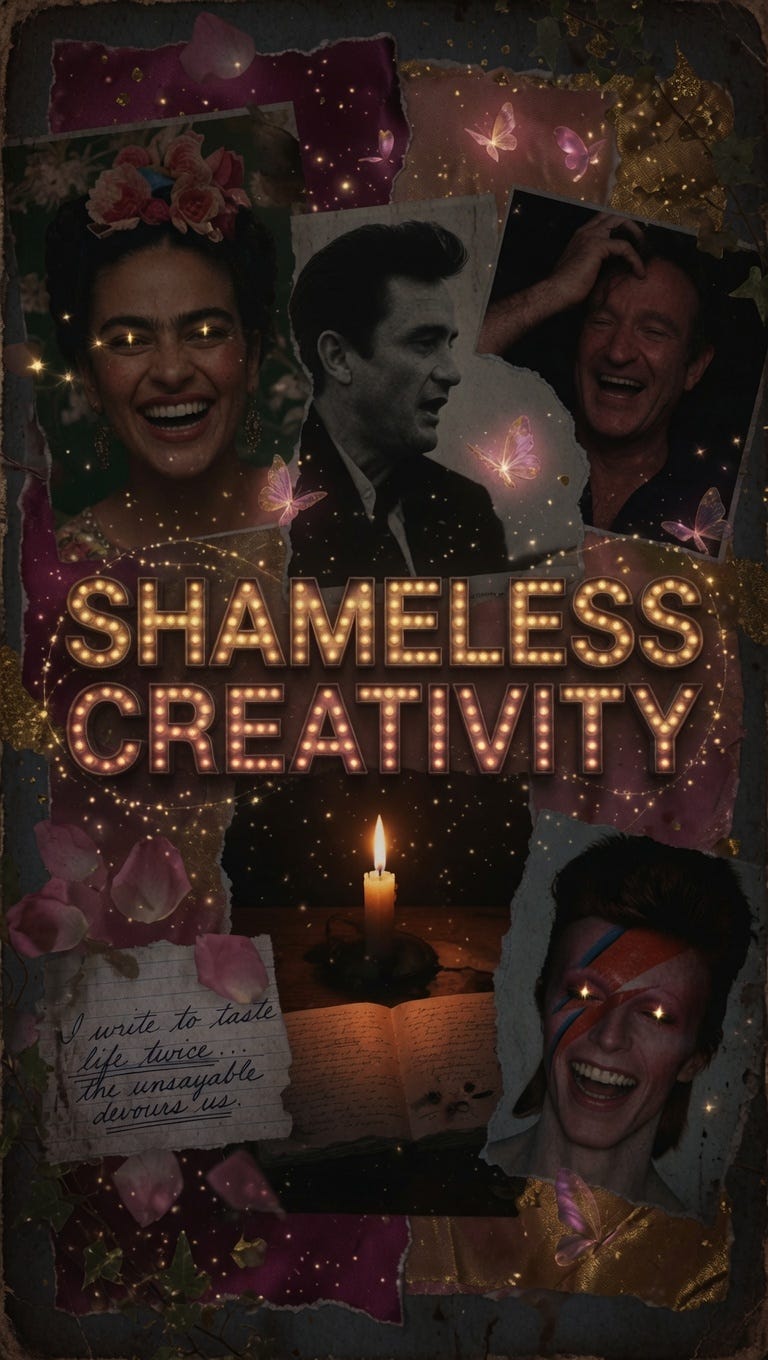
We’re spending June on shameless creativity. What it actually means to make things without apology. Without shrinking the work to fit. Without waiting for permission from people who were never going to give it anyway.
That’s the conversation we’re having. Live sessions, writing prompts, a community of people who are done being nonchalant about the things they actually care about.
If that’s you, sign up now!